


Sandra's First Taste of Risk Management's Value
The Benefit of an Early Misstep


dragana991 photo
"How much are the pumpkins?" she asked in a velvety voice. Her long skirt whipped gently in the brisk fall breeze. Her innocent face and quick smile overcame the cold eyes Sandra still remembers almost 60 years later.
"Twenty five cents for the big ones and 15 cents for the small ones," Sandra recited breathlessly, recalling how Eddie, her 12-year-old brother, told those who stopped along their edge-of-town farm to buy pumpkins that October.
To Sandra's surprise, she seemed to understand the words Sandra managed to squeeze out as the adrenaline raced through her body. She had gotten her feet to track quickly enough to go down five steps and open the front door before the customer-to-be had decided no one was home.

"Can I go and look at them?" she asked cheerfully.
"Sure," Sandra replied, glad she could stay at the glass storm door and watch her pick out her pumpkins without going outside and stumbling behind her in an uneasy gait that is often one of the marks of cerebral palsy.
Sandra was the only one home, but she didn't want Eddie to lose a sale just because he wasn't there. It was his project, and Sandra didn't understand why he was not yet home from school. At 5:30, he was usually adding new pumpkins from the field out back to the sidewalk that led from the driveway to the house. Their mother, Pat, usually home by the time Sandra returned from school, was shopping, and Ted, their father, was still at work.
The breeze swirled golden leaves across the sidewalk as Sandra watched the lady walk back and forth along the row of pumpkins. Sandra remembered Eddie's cash box was on the kitchen table and quickly traced the steps in her mind she would have to take, without falling, if she would have to make change. The lady then came back to the house.
"I'll take those two," said the woman, as Sandra reopened the door. She pointed to one larger pumpkin and one small pumpkin along the sidewalk.
"That'll be 40 cents," Sandra said abruptly, trying to quickly show she knew what she was doing. But she garbled the "f" sound, stuttering so badly in the rush that what came out of her mouth sounded unintelligible even to her.
"Pardon?" the woman asked briskly. Her cold, gray eyes suddenly complemented the frown on her forehead. She didn't understand.
Don't blow this, Sandra told herself. After all, she was nearly 10 years old. If Eddie could sell pumpkins, she could, too. Sandra was again short of breath.

JOIN OUR LIVE CHAT on 11/24/2024. Check my new, amusing social predicament tale, which is first available for all of us on Sunday’s (11/24/2024) live chat at 1:00 p.m. central. Watch your email on Saturday noon and Sunday noon for the link to the 1:00 Sunday live chat. - Jim Hasse
"That'll be f-o-r-t-y cents," she repeated slowly in another choppy, breathless sentence that came out more clearly.
"Yes," she agreed. She understood and concurred. Sandra's confidence again began to bounce back from its deficit. The lady opened her purse.
"Do you have change?" she asked in a pleasant but strangely staccato manner.
"Yes," Sandra answered, again imagining how long it would take for here to climb up the steps to the kitchen and come back with a fist full of change.
The lady handed her what Sandra thought was a five-dollar bill. It felt crisp and new, as though it had never been folded before.
"I'll be right back," Sandra assured her. Sandra would be back. She need not worry. It would take some time. But Sandra would be back.
With the bill between her left thumb and forefinger, Sandra climbed the five steps up to the kitchen on her hands and knees and pulled herself up to a standing position. Sandra looked back and saw the lady glancing at her through the storm door.
Sandra threw the woman's bill on the table and opened Eddie's cash box. The bills in the box, stacked neatly in a loose bundle, popped up as she opened the lid. Sandra quickly scattered them on the table to see what he had. Lots of ones. Some fives. Some tens.
Sandra counted out four ones, retrieved two quarters and a dime from the box and stuffed them tightly into her right fist so she could use her left hand to gingerly paw the railing as she descended the stairs to the front door, one step at a time.
It was Sandra's first sale. Eddie would be so proud, she thought, as she again reached the front door.
Sandra opened the storm door and, instead of counting out the bills one by one, handed the lady her change in one sweaty wad.
"That's four dollars and 60 cents," Sandra managed to get out in a voice that was again short of breath.
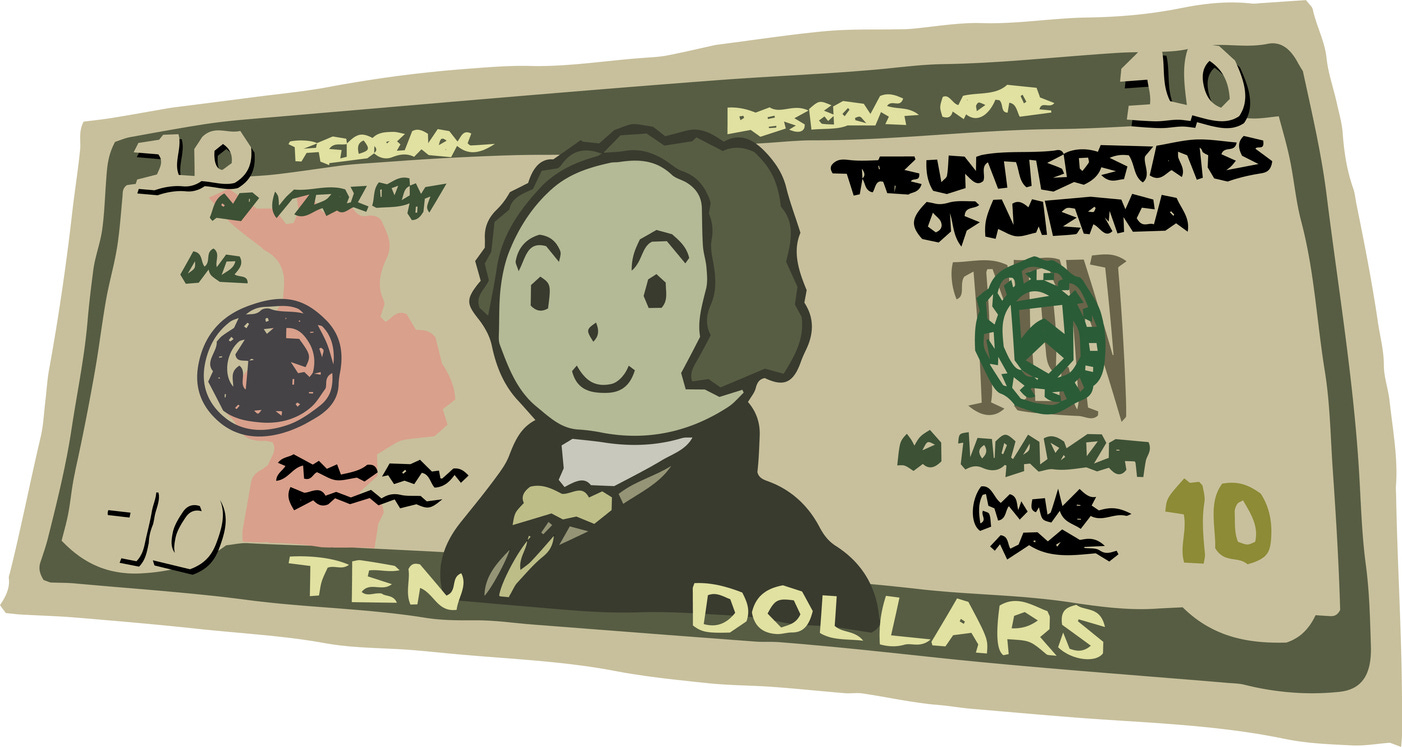
The lady fingered through the bills and looked puzzled. "I gave you a 10-dollar bill," she said with authority. "I need another five."
"Oh ... I thought you gave me a five," Sandra said with an unsure, apologetic quiver. "Let me check."
She bounced back up the steps again, asking herself how she could mistake a ten for a five. As she pulled herself up from her kneeling position at the top of the stairs, Sandra again saw Eddie's cash scattered across the table, just as she had left it. She gathered up the fives, four in all. They were all crisp, and Sandra couldn't recall how many there were when she took them out of the cash box.
She began to panic. "You're taking too long," Sandra told herself. "She'll wonder if you're ever coming back to the front door."
Sandra counted out three tens. Two were well worn, but one was crisp. Was that the one she had given Sandra? It was crumpled. How could she make such a mistake?
Sandra wished Eddie was home. He would know what to do. He would know how much cash he had on hand. She looked for a slip of paper or a note in the box to show a current total for cash on hand. Nothing.
She must be right, Sandra told herself. She grabbed a five, scooted down the steps and threw herself off balance with her contortions upon reaching the landing. In what seemed like a fall in slow motion, she desperately reached for the storm door and caught it with her right-hand knuckles just in time to avoid a belly flop in front of the lady.
"Here's your five," Sandra heard herself say, more aware of the temporary ache in her knuckles than the lady at the door.
"Thank you, young lady," she replied with a faint smile as she put the bill in her purse. She slung her purse over her shoulder and took the pumpkins -- one by one -- to her car, as Sandra watched from the door.
Sandra took a deep breath as the lady drove out of the yard -- relieved, excited and proud about making her first pumpkin sale. Though next time, Sandra promised herself, she would pay closer attention to the business of making change.
She went back to the kitchen table, counted out the bills and change and put the money neatly back into the box with a note, which read, "October 14, 1955: $61.75."
When Eddie returned home that evening, Sandra eagerly told him she had sold two more of his pumpkins. But, when he recounted the money in his cash box, he found himself short of what he had the night before by five dollars.
As a mature adult, Sandra now values the pumpkin incident as part of her journey toward eventually becoming vice president of risk management for Goldman Sachs.
At 78, she can vouch for Thomas Henry Huxley's insight when he wrote:
"There is the greatest practical benefit in making a few failures early in life." - On Medical Education
Sandra's takeaway tip from her story: Become proficient in managing the risk inherent in vulnerability.

Here’s to mature-adult living!
Jim Hasse, ABC, GCDF retired, author of “52 Shades of Graying”
Sharing our Insights Each Week as We Discover New Shades of Aging
Accolade: “I resonated with your story!" - Kathleen M.
How to use “My Latest Legacy Nugget” resources to share
your “52 Shades of Graying” comment with a family member or friend.
Template for “My Latest Legacy Nugget” note - birthday
Template for “My Latest Legacy Nugget” note - graduation day
Template for “My Latest Legacy Nugget” note - holiday greeting
Template for “My Latest Legacy Nugget” note - special day
Template for “My Latest Legacy Nugget” note - wedding anniversary
Template for “My Latest Legacy Nugget” note - wedding day
See all past issues of “52 Shades of Graying.”
See all past chats of “52 Shades of Levity.”
Check guidelines for your “52 Shades of Graying” Discussion Group.
I grew up in a social environment which taught me that we, as people, were not to be trusted to do good. We were basically selfish, looked out largely for ourselves instead of others and, therefore, could not be trusted and needed to be controlled from the top down.
In other words, it was risky to rely on the generosity and goodwill of others. It was safer to avoid people, especially crowds of people.
I still may be naive, but I’m now willing to bet that, given a fair shake, most people can manage their own affairs effectively and are willing to help others when they see a need. At 81, with life-long cerebral palsy and a person often needing help, I can give you multiple examples, some of which occur almost daily, in which people are willing to stop to help me when I need it.
Two years ago, Pam and I decided to shop at Trader Joe’s in downtown Minneapolis for the first time. I had my druthers due to recent carjackings. After all, we are always prime targets because we drive a nice car and move so slowly in getting in and out of the car and stashing the groceries in the back seat.
So, instead of risking the people-desert of a nearby parking garage, my plan was to leave Pam right at the front door of Trader Joe’s (only 11 minutes from home) and then pick her up again at the same busy spot when she had finished shopping.
To my surprise, the pickup spot was again vacant when I returned. Pam was sitting inside by the window and, as I was calling her on my phone, a man with flowers in his hand and also waiting for his ride outside of the store, recognized I was trying to get her attention, tapped on the window and helped Pam navigate her grocery cart through the store’s entry way to our car.
A woman who was passing by on the sidewalk then offered to help Pam put our five bags of groceries in the back seat of our car with the parting words, “Stay safe.”
* Now that you’re a mature adult, how is your approach to risky situations different than it was when you were a youngster?