


Your audio-and-text option:
Listen to Buddy’s story as you read it (below).
The world of Buddy’s garden was a world of its own. For 50 years, he had tended to it, his hands in the dirt, his knees on the ground. The soil knew him, and he knew the soil.
It was a place of quiet triumph, where he could forget about the outside world and focus on the simple perfection of a ripening tomato.
But lately, it had become a place of quiet defeat. His back, a loyal servant for decades, had staged a full-scale rebellion. The simple act of kneeling had become an agonizing chore.
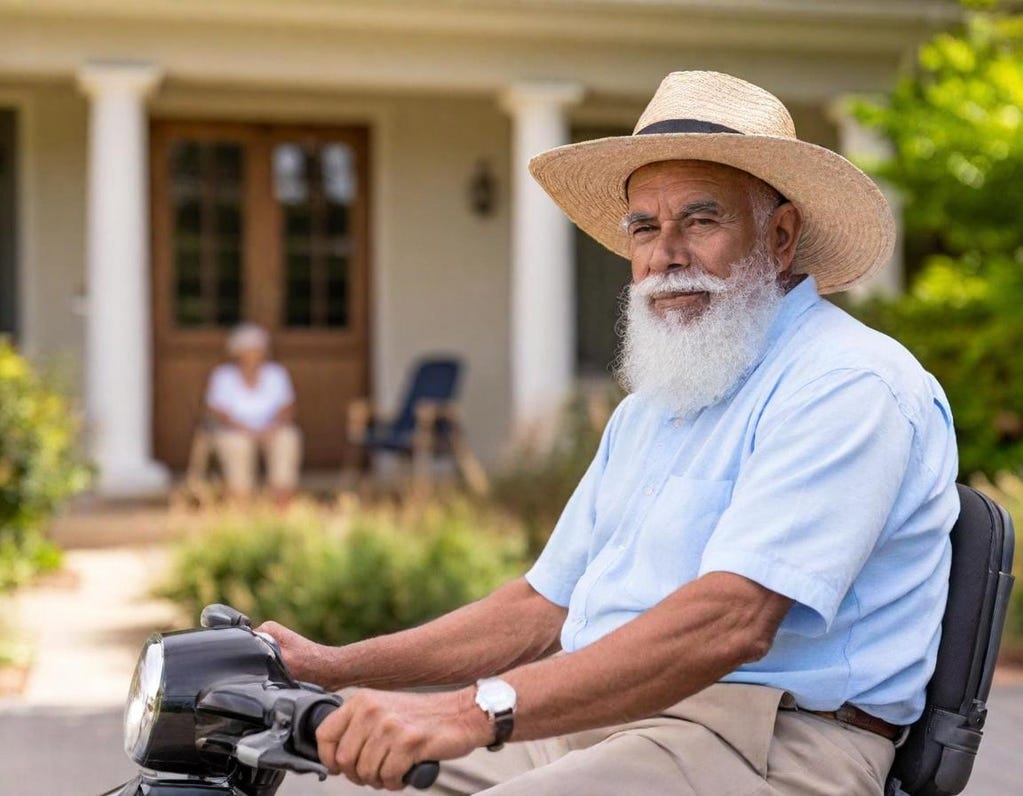
“It’s just too much,” he told his wife, Lily, one afternoon, the words tasting like ash in his mouth. He sat in his mobility scooter, watching her effortlessly pull weeds, roots and all, from the ground and then patting the soil as compensation for the disturbance. “I can’t do it anymore.”
Lily, ever practical, just patted the ground. “Then don’t. We’ll figure something out.”
A few days later, a truck delivered a pile of lumber and bags of soil to their driveway. Buddy watched from the window, a look of bewilderment on his face. “What in the world is all that?” he asked.
“It’s the future of your garden,” Lily said, a confident smile on her face. “A raised bed. With a bench, no less.”
Buddy’s heart sank a little. The idea of a raised bed felt like a concession, a surrender to his failing body. He had always been a man of the earth, and now he was going to be a man in a box. It felt wrong.
He stayed in his scooter, watching Lily and a neighbor assemble the wooden frame. They filled it with the new soil, rich and dark, and then attached a long, sturdy bench along one side.
The next morning, Buddy wheeled himself over to the new structure. He looked at the raised bed, the perfect lines of the lumber, the clean soil. It didn’t feel like his garden. It felt like a piece of furniture, an art installation.
But then he looked at the built-in bench. It was a perfect height for his scooter. He maneuvered himself alongside it and, with a careful turn in his scooter seat, he slid himself from the scooter seat to the bench.
He looked down at the soil, so close and so clean. He reached out with his right hand. The dirt was cool and soft under his fingers. He had to admit, it was a lot easier than getting down on the ground.
He leaned forward and, with a small trowel, began to plant his new tomato seedlings. He worked slowly, deliberately, the small ache in his back a distant memory. He could see the whole bed, could reach every corner, and he felt a new kind of freedom.
He had been so focused on what he was losing — the ability to kneel, the feeling of the earth against his knees — that he hadn’t thought about what he was gaining: a new way to be in his garden. A way to continue his passion without the pain. The raised bed wasn’t a surrender. It was a liberation.
A few months later, the garden was a vibrant, sprawling jungle of green. The tomato plants were taller than ever, their branches heavy with plump, red fruit. Buddy sat on the bench, contented with the basket of ripe tomatoes resting on the scooter’s seat. Lily came out to join him, sitting beside him on the bench.
“They’re beautiful, honey,” she said, reaching for a tomato.
“They are,” he agreed. He looked at the garden, a small kingdom of his own making, a place of peace and joy. He looked at Lily, who had helped him build it, and felt a profound sense of gratitude.
He had been afraid of what the future held. But with a little bit of ingenuity, he had found a new way to garden.
The garden wasn’t just a garden anymore. It was a testament to his resilience, a symbol of a life that was still growing, still thriving.
And it was all thanks to a simple wooden box and a bench.

Also hear and read this “parent story” from 2024:
Go to “Earl’s Journey into Retirement.”
Age: Our greatest asset!
Jim Hasse, ABC, GCDF retired, author of “52 Shades of Graying”
Weekly Stories About Aging Well
“It’s impossible not to love someone whose story you’ve heard.” - Mary Lou Kownacki
Stories about addressing ageism.
Stories about handling ableism.
Stories about thriving during the second half of life.
Accolade: “Love reading your stories. You never disappoint.” - Mary K.
How to use “My Latest Legacy Nugget” resources to share
your “52 Shades of Graying” comment with a family member or friend.
Template for “My Latest Legacy Nugget” note - birthday
Template for “My Latest Legacy Nugget” note - graduation day
Template for “My Latest Legacy Nugget” note - holiday greeting
Template for “My Latest Legacy Nugget” note - special day
Template for “My Latest Legacy Nugget” note - wedding anniversary
Template for “My Latest Legacy Nugget” note - wedding day
See all past issues of “52 Shades of Graying.”
See all past chats of “52 Shades of Levity.”
Check guidelines for your “52 Shades of Graying” Discussion Group.
During the 1970s and 1980s (long before digital cameras), I became a half-way proficient photographer as a corporate communication director for a regional dairy cooperative – even though I walked and talked with difficulty due to lifelong cerebral palsy.
I learned to use the folding tripod for my film camera as a walking stick (a replacement for my right Canadian crutch, which dangled from my other crutch's forearm – all because I didn’t have the reliable balance to stand or walk freely without aid.
I was the co-op’s photographer for about 12 years until I became vice president for corporate communication and developed a five-person staff, which included a non-disabled photographer.
* How have you used ingenuity to pursue an activity which may seem at first unreasonable to others?